What Is the FM 02V2 Flexible Feeding Automatic Tape and Reel Machine
- Publish Time: 2025-11-24 22:19:51
- Click Count: 3
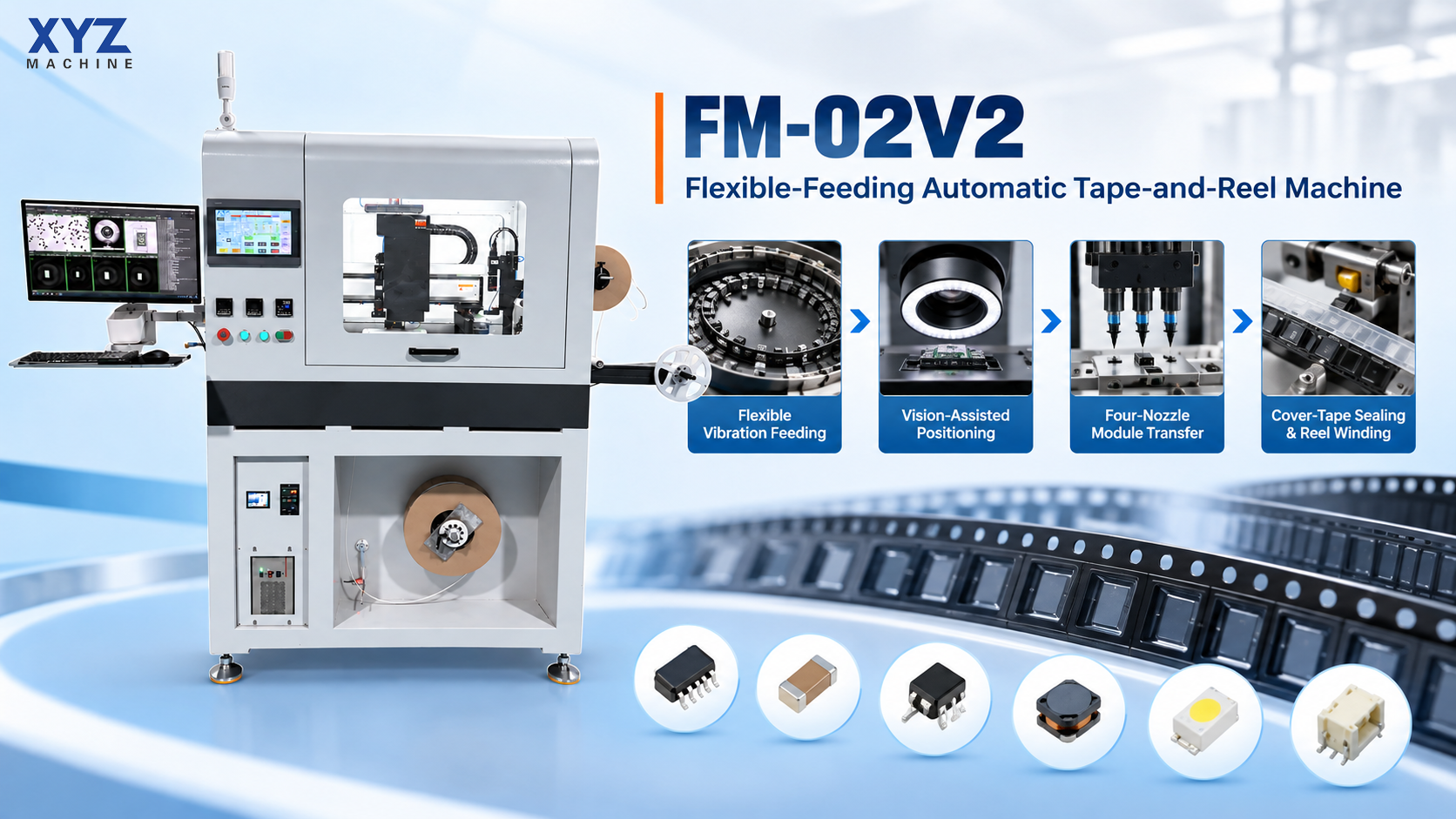
The FM-02V2 Flexible-Feeding Automatic Tape-and-Reel Machine is an automated packaging system designed for suitable loose electronic components that require feeding, orientation recognition, transfer, carrier-tape placement, sealing and reel winding.
The machine combines flexible vibration feeding, vision-assisted positioning and four-nozzle transfer. Suitable components are placed into carrier-tape pockets, followed by cover-tape sealing and winding.
Unlike a fixed machine configuration that assumes every component can be handled in the same way, the FM-02V2 is configured around the actual component and packaging requirement.
Feeding stability, orientation recognition, carrier-tape pocket fit and achievable output should be evaluated with real samples before final configuration.
This makes the FM-02V2 particularly relevant for electronic component manufacturers and packaging service providers that need a more flexible tape-and-reel automation process.
How Does the FM 02V2 Work
The FM-02V2 follows a structured automatic tape-and-reel packaging process.
Process Stage | Function |
Flexible Vibration Feeding | Separates and presents suitable loose components |
Vision Recognition | Identifies component position and orientation |
Four Nozzle Transfer | Transfers recognized components toward the carrier tape |
Carrier Tape Placement | Places components into matched tape pockets |
Heat Sealing | Seals the cover tape over the carrier tape |
Reel Winding | Winds the finished tape into reel format |
The feeding and transfer configuration uses a flexible vibration tray, vision recognition and four-nozzle transfer.
Why Flexible Feeding Matters
Loose electronic components do not all behave the same way.
Some parts separate easily, while others may stick together, overlap, rotate unpredictably or present unstable surfaces.
The flexible vibration feeding system is designed to present suitable loose components for recognition and transfer without relying entirely on a dedicated mechanical bowl feeder.
This can provide greater flexibility when handling different component types.
However, flexible feeding does not mean universal compatibility. The actual part must still be evaluated based on its size, geometry, surface characteristics, weight and behavior during feeding.
How Vision Assisted Positioning Supports Tape and Reel Packaging
Vision-assisted positioning is used to determine where a component is located and how it is oriented before transfer.
This is important because tape-and-reel packaging requires components to enter the carrier tape in a defined direction.
Evaluation Question | Why It Matters |
Can the component be detected reliably | Determines whether vision recognition is stable |
Can the required orientation be identified | Ensures correct placement direction |
Can the pickup point be located consistently | Supports reliable nozzle transfer |
Can abnormal presentation be recognized | Helps reduce incorrect placement |
The actual recognition result depends on the component itself, which is why clear front and back photos and real samples are important during the application review.
What Is the Role of the Four Nozzle Transfer Module
The FM-02V2 uses a four-nozzle transfer module as part of the automated handling process.
The transfer module moves recognized components from the feeding area toward the carrier tape.
A four-nozzle arrangement can support a structured transfer sequence, but final performance depends on the actual component.
Factors that may affect transfer include component geometry, pickup surface, component weight, orientation stability, surface reflectivity and carrier-tape pocket position.
For this reason, real sample testing is required before the final configuration is confirmed.
Carrier Tape Compatibility
Carrier tape must be reviewed together with the component.
For plastic carrier tape, the FM-02V2 has a reference width range of 8-32 mm, subject to component and pocket review.
For paper carrier tape, the reference configuration includes dedicated 8 mm and 12 mm tracks.
The carrier tape cannot be selected only by width. The pocket must also match the component outline, thickness and required orientation.
Reference Component Size
Dimension | Reference Range |
Length | 2.0-20.0 mm |
Width | 1.2-18.0 mm |
Thickness | 0.4-6.0 mm |
Sample validation is required. These values should be treated as proposal reference ranges, not as a guarantee that every component within the dimensions will be suitable.
Why Carrier Tape Pocket Fit Is Important
Pocket fit is one of the most important factors in tape-and-reel packaging.
If the pocket does not match the component properly, the part may move, rotate, tilt or fail to sit correctly.
The application review should therefore consider several dimensions together.
Review Item | Purpose |
Component Length and Width | Determines pocket outline |
Component Thickness | Determines required pocket depth |
Orientation | Defines the required placement direction |
Side Clearance | Controls unnecessary movement |
Tape Width | Determines track compatibility |
Pocket Position | Affects nozzle placement accuracy |
A successful FM-02V2 project depends on matching the part and carrier tape rather than selecting the machine independently from the packaging material.
Heat Sealing
The FM-02V2 uses heat sealing.
The sealing temperature, pressure and tape combination should be validated through trials.
This is important because sealing performance depends on both the carrier tape and cover tape.
The correct sealing process should provide stable closure without affecting the component or downstream tape handling.
Reel Winding
After components are placed and the cover tape is sealed, the finished carrier tape is wound into reel format.
This prepares the packaged components for storage, shipment or downstream SMT-related use.
The complete workflow can be summarized as: Flexible Feeding -> Vision Recognition -> Four-Nozzle Transfer -> Carrier Tape Placement -> Heat Sealing -> Reel Winding.
Continuous Output Is Determined by Trial
The FM-02V2 does not have one universal continuous output value for every component.
Continuous output is established through trials with the actual component and packaging process.
Several factors can influence achievable output.
Factor | Potential Impact |
Component Size | Influences feeding and pickup speed |
Component Shape | Affects separation and orientation |
Surface Condition | May affect vision and pickup |
Orientation Requirement | Influences recognition time |
Carrier Tape Fit | Affects placement stability |
Sealing Process | Influences cycle timing |
Feeding Stability | Affects overall continuity |
This is why sample-based validation is more reliable than quoting one fixed production speed.
Reference Technical Specifications
Item | Reference Specification |
Feeding and Transfer | Flexible vibration tray, vision recognition, four-nozzle transfer |
Plastic Carrier Tape | 8-32 mm reference width |
Paper Carrier Tape | Dedicated 8 mm and 12 mm tracks |
Reference Component Size | L 2.0-20.0 x W 1.2-18.0 x T 0.4-6.0 mm |
Sealing | Heat sealing |
Power Supply | AC 220 V, 50 Hz |
Air Supply | 0.5-0.7 MPa |
Approximate Size | 1896 x 800 x 1840 mm |
Approximate Weight | 380 kg |
These figures are reference values only and should be confirmed against the final machine configuration.
Which Components Require Additional Review
Some components require separate evaluation, including 0402 and smaller components, sticky parts, transparent parts, highly reflective components and parts with easily bent leads.
These characteristics can make feeding, recognition or pickup more difficult. For these components, a more detailed application review is necessary before confirming machine suitability.
How to Assess a Component Before Choosing the FM 02V2
Can the loose components separate consistently
If parts cannot separate reliably, feeding stability may be difficult to achieve.
Can the vision system identify the orientation
If the component cannot be recognized consistently, automatic placement may not be reliable.
Does the carrier tape pocket match the component
The component outline, thickness and packaging direction must match the carrier-tape pocket design.
These three checks form the foundation of the FM-02V2 application review.
What Information Is Needed for an Application Review
Required Information | Why It Is Needed |
Dimensioned Component Drawing | Confirms size and geometry |
Front and Back Photos | Helps evaluate appearance and orientation |
Required Orientation | Defines packaging direction |
Carrier Tape Drawing | Confirms pocket dimensions |
Cover Tape Drawing | Supports sealing review |
Expected Volume | Helps evaluate production requirements |
Actual samples are recommended where possible.
Who Is the FM 02V2 Suitable For
Customer Type | Typical Requirement |
Electronic Component Manufacturers | Automated packaging of loose parts |
Packaging Service Providers | Flexible tape-and-reel processing |
OEM and EMS Factories | Component repacking and production support |
R&D Teams | New component packaging validation |
Engineering Departments | Customized packaging projects |
Component Suppliers | Conversion of loose parts to reel format |
The final suitability depends on the actual component and packaging process.
FM 02V2 Compared with Fixed Feeding Systems
Flexible feeding is not automatically better than every fixed feeding method. The correct choice depends on the component.
Factor | Flexible Feeding | Fixed Mechanical Feeding |
Product Flexibility | Higher | Usually lower |
Changeover Potential | Better for suitable parts | More tooling dependent |
Component Sensitivity | Requires evaluation | Can be optimized for one part |
Vision Dependence | Higher | May be lower |
Best Use Case | Multiple suitable loose components | Stable high-volume single part |
The FM-02V2 is most valuable when flexibility is required and the actual components can be separated, recognized and transferred reliably.
Frequently Asked Questions
What is the FM-02V2
The FM-02V2 is a flexible-feeding automatic tape-and-reel machine designed for suitable loose electronic components.
How does the FM-02V2 feed components
It uses a flexible vibration tray together with vision recognition.
Does the machine use vision positioning
Yes. Vision-assisted positioning is used to identify component position and orientation.
How are components transferred
The machine uses a four-nozzle transfer module.
What carrier tape width does the FM-02V2 support
The reference width for plastic carrier tape is 8-32 mm. Paper carrier tape uses dedicated 8 mm and 12 mm tracks.
What component sizes are supported
The reference component size is 2.0-20.0 mm in length, 1.2-18.0 mm in width and 0.4-6.0 mm in thickness. Sample validation is required.
What sealing method is used
The FM-02V2 uses heat sealing.
Is the production speed fixed
No. Continuous output is established through trials with the actual component and packaging process.
Can every loose component be used
No. The reference ranges are not a compatibility guarantee for every component. Certain parts require separate evaluation.
Conclusion
The XYZ FM-02V2 Flexible-Feeding Automatic Tape-and-Reel Machine combines flexible vibration feeding, vision-assisted positioning, four-nozzle transfer, carrier-tape placement, heat sealing and reel winding into one automated packaging process.
Its key advantage is flexibility, but that flexibility depends on correct application assessment.
The component must be evaluated for feeding stability, vision recognition, orientation, pickup condition and carrier-tape pocket fit before final configuration.
For manufacturers working with suitable loose electronic components, the FM-02V2 provides a practical way to automate tape-and-reel packaging while retaining a sample-based engineering approach.
