Tray to Reel Automatic Taping Machine TTR 400 for SMD Component Packaging
- Publish Time: 2025-11-24 22:19:51
- Click Count: 3
Tray to Reel Automatic Taping Machine TTR 400 for SMD Component Packaging
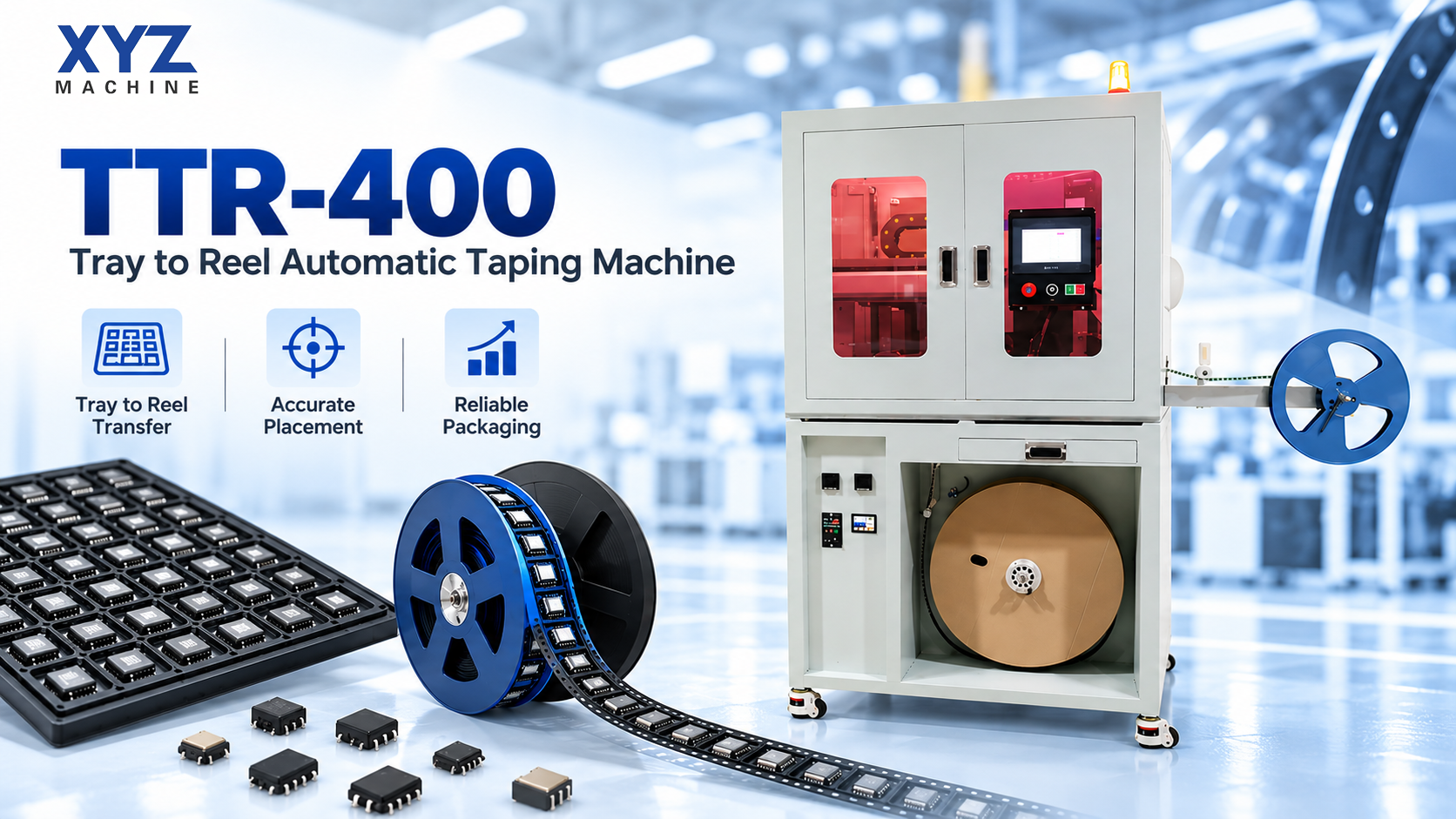
A tray to reel automatic taping machine converts tray-loaded electronic components into carrier tape and finished reels for downstream SMT production. The XYZ TTR-400 is designed for this job: it picks suitable SMD components from trays, positions them into matched carrier tape pockets, seals the tape and completes reel winding in one automated process.
For semiconductor manufacturers, component suppliers, OEM factories and EMS production lines, tray-to-reel conversion is often required when parts arrive in JEDEC or customized trays but the next assembly process expects tape-and-reel packaging.
In simple terms: Tray in, component pickup and positioning, carrier tape placement, sealing, reel out. |
What Is a Tray to Reel Automatic Taping Machine
A tray to reel machine is an automated packaging system that transfers electronic components from trays into carrier tape. It is different from a standard taping machine mainly because the incoming material format is already organized in trays rather than supplied as loose parts, tubes or bulk components.
Process Stage | What Happens |
Tray Feeding | Components are supplied in JEDEC or application-specific trays. |
Component Pickup | The pick-and-place system removes parts from the tray. |
Orientation and Alignment | The component position is checked and corrected before placement. |
Carrier Tape Placement | The part is placed into the corresponding carrier tape pocket. |
Cover Tape Sealing | Cover tape secures the component in the pocket. |
Reel Winding | Finished carrier tape is collected into reel format. |
This process is especially relevant for ICs, semiconductor packages, LEDs, sensors and other components that are commonly stored or transported in trays before final tape-and-reel packaging.
Why Tray to Reel Conversion Matters in SMT Production
Tray packaging is convenient for handling many semiconductor and precision electronic parts, but high-speed SMT lines typically rely on feeder-compatible tape-and-reel packaging. That creates a conversion step between incoming component storage and automated assembly.
A controlled tray-to-reel process reduces repeated manual transfer and makes component presentation more consistent before the parts reach pick-and-place equipment. It also helps standardize reel output for storage, shipment and downstream production.
Production Need | Why Tray to Reel Helps |
SMT Feeder Compatibility | Converts tray-loaded parts into carrier tape format for feeder use. |
Repeat Packaging | Creates a more repeatable process than manual repacking. |
Orientation Control | Maintains the required component direction before sealing. |
Reduced Manual Handling | Limits repeated operator contact with components. |
Finished Reel Output | Provides an organized packaging format for production or shipment. |
TTR-400 Reference Technical Data
The current TTR-400 product configuration provides the following reference data. Actual output and final machine configuration depend on the component, tray format, carrier tape design and packaging process.
Parameter | Reference Specification |
Placement Speed | UPH 1500 to 5000 |
Carrier Tape Range | 12 to 56 mm reference range |
Machine Dimensions | Approx. D 1100 × W 1000 × H 1550 mm |
Machine Weight | Approx. 350 kg |
Main Process | Tray feeding, pick and place, carrier tape placement, sealing and reel winding |
For non-standard components or trays, sample review is recommended before the final configuration is confirmed.
JEDEC Tray Feeding and Automated Pick and Place
The starting point of the TTR-400 is the tray. Components are presented in an organized layout, allowing the pick-and-place system to move from a known tray position to the carrier tape pocket.
This is particularly useful for semiconductor packages and precision components that are already supplied in JEDEC trays. For customized tray formats, the tray dimensions, pocket layout and component orientation should be reviewed during application evaluation.
A reliable tray-to-reel setup depends on more than the robot motion itself. Tray consistency, part pickup surface, component weight, orientation and the available gripping or suction area can all affect the transfer process.
Why Vision Alignment Matters
Correct orientation is critical in tape-and-reel packaging. A component can be physically inside the carrier tape pocket and still be unusable if it is rotated or positioned incorrectly for downstream assembly.
The TTR-400 product configuration uses vision alignment to support orientation control and placement verification. This is especially relevant for IC packages, sensors, optoelectronic components and other parts where top-side markings or package direction matter.
Vision Task | Production Value |
Orientation Check | Helps confirm that the component is facing the required direction. |
Position Alignment | Supports consistent placement into the carrier tape pocket. |
Missing Part Detection | Helps identify incomplete placement before sealing. |
Placement Verification | Reduces the risk of misaligned components entering the finished reel. |
Carrier Tape Selection Is Part of the Machine Setup
A tray-to-reel machine cannot compensate for an unsuitable carrier tape pocket. The pocket needs to match the component geometry closely enough to control movement while still allowing reliable placement and downstream pickup.
Component Factor | Carrier Tape Consideration |
Length and Width | Determines the pocket outline and clearance. |
Thickness | Determines pocket depth. |
Package Shape | Influences cavity geometry and support points. |
Required Orientation | Defines how the component sits in the pocket. |
Pickup Surface | Affects downstream SMT handling. |
Movement Allowance | Controls rotation, tilting and vibration inside the pocket. |
For this reason, machine selection and carrier tape design should be treated as one packaging project rather than two separate decisions.
What Components Can the TTR-400 Package
The TTR-400 is intended for suitable tray-loaded electronic components. Final compatibility should be confirmed against the actual sample, tray and carrier tape design.
Semiconductor Devices
Typical applications include QFN, DFN, SOP, BGA, MOSFETs and suitable small IC packages. These parts are commonly handled in trays and often need tape-and-reel output for SMT assembly.
LED and Optoelectronic Components
LED chips, photodiodes and optical sensors may also be suitable when the component surface and pickup area support stable handling.
Sensors and MEMS Devices
Hall sensors, MEMS chips and micro sensors can require accurate orientation and careful pocket matching, making tray-to-reel conversion a practical option for selected products.
Connectors and Mechanical Parts
Micro connectors, metal terminals and stamped parts may be suitable when tray layout, pickup method and carrier tape geometry are compatible.
Tray to Reel Machine vs Other Taping Machine Types
The most important difference between taping machines is often the incoming component format. Choosing the wrong feeding concept can make a technically capable machine unnecessarily complicated.
Machine Type | Incoming Component Format | Best Fit |
Tray to Reel | JEDEC or customized trays | Tray-loaded ICs, sensors, LEDs and precision components |
Tube to Reel | Tubes | Components already supplied in tubes |
Flexible Feeding Taping Machine | Loose parts | High-mix loose components with adaptable feeding |
Semi-Automatic Taping Machine | Manual/operator-assisted | Small batches, R&D and frequent changeovers |
Reel to Reel | Existing reel/tape format | Continuous processing or rework of reel-based material |
For components already organized in trays, a tray-to-reel configuration is usually the most direct route to carrier tape packaging because it starts from the existing incoming format.
Automatic Tray to Reel vs Manual Repacking
Manual repacking can work for very small quantities, but it becomes harder to maintain consistency as production volume grows. Automated tray-to-reel packaging is designed to make the transfer process more repeatable.
Factor | Automatic Tray to Reel | Manual Repacking |
Component Pickup | Automated | Operator dependent |
Placement Consistency | Repeatable when setup is validated | Varies by operator |
Orientation Control | Supported by machine setup and vision | Relies on manual checking |
Reel Winding | Integrated | Manual or separate process |
Best Volume Range | Repeat or larger batches | Very small batches or special handling |
Who Typically Uses a Tray to Reel Automatic Taping Machine
User Type | Typical Requirement |
Semiconductor Manufacturers | Convert IC packages from trays to feeder-ready tape and reel. |
Electronic Component Suppliers | Prepare components for customer SMT lines or shipment. |
OEM Factories | Standardize incoming parts for internal assembly. |
EMS Manufacturers | Handle customer-specific packaging conversions. |
LED and Sensor Manufacturers | Package precision parts with controlled orientation. |
Tape and Reel Service Providers | Offer tray-to-reel conversion as a contract service. |
What to Check Before Choosing a Tray to Reel Machine
A useful equipment review starts with the component and tray, not the machine brochure. The following information helps determine whether the application is straightforward or needs a customized setup.
Information Required | Why It Matters |
Component Drawing | Confirms dimensions, thickness and geometry. |
Front and Back Photos | Helps evaluate orientation and pickup surfaces. |
Tray Drawing or Clear Photo | Confirms tray size, pocket pitch and component layout. |
Required Tape Orientation | Defines how the component must sit in the carrier tape. |
Carrier Tape Drawing | Confirms pocket dimensions and tape width. |
Cover Tape Information | Supports sealing setup. |
Expected Production Volume | Helps determine the appropriate automation level. |
Physical Samples | Allows practical feeding, placement and sealing evaluation. |
Why UPH Should Not Be the Only Buying Criterion
The TTR-400 has a reference placement speed of UPH 1500 to 5000, but nominal speed does not automatically equal effective production output. A tray-to-reel line only performs well when pickup, orientation, pocket placement, sealing and reel winding remain stable together.
A machine running at a slightly lower but repeatable rate may deliver better real-world output than a faster setup that requires frequent intervention. For equipment selection, the complete packaging cycle is more important than one headline speed figure.
TTR-400 for OEM and EMS Production
OEM and EMS factories often receive components in several packaging formats. When tray-loaded parts need to enter a tape-fed SMT process, tray-to-reel conversion can become a regular part of production rather than an occasional repacking task.
The TTR-400 is intended for these repeat workflows, where automated pickup, controlled orientation and finished reel output can reduce manual handling and make the packaging step easier to standardize.
XYZ Tape Reel Packaging Solutions
The TTR-400 is part of the XYZ Tape Reel automatic taping machine range. XYZ also provides equipment and supporting solutions for other component feeding formats and packaging stages.
XYZ Solution | Main Application |
Tray to Reel Automatic Taping Machines | Tray-loaded components |
Reel to Reel Automatic Taping Machines | Continuous reel-based processing |
Flexible Taping Machines | Loose components and high-mix production |
Semi-Auto Taping Machines | Operator-assisted small and medium batches |
Carrier Tape Forming Lines | In-house carrier tape production |
Carrier Tape and Accessories | Component-specific packaging materials |
Taping Processing | Contract tape-and-reel packaging |
Custom Automation | Non-standard component packaging projects |
Frequently Asked Questions
What is a tray to reel automatic taping machine?
It is a packaging machine that picks electronic components from trays, places them into carrier tape, seals the tape and winds the finished material into reels.
Does the TTR-400 work with JEDEC trays?
The product is designed around tray-fed SMD packaging, including JEDEC tray applications. The actual tray format should be reviewed before final configuration.
What is the reference placement speed of the TTR-400?
The current reference range is UPH 1500 to 5000. Actual output depends on the component, tray layout and packaging setup.
What carrier tape range does the TTR-400 support?
The current product data lists a 12 to 56 mm reference range. Pocket compatibility still depends on the actual component.
What components can be packaged?
Potential applications include QFN, DFN, SOP, BGA, MOSFETs, small IC packages, LEDs, photodiodes, MEMS devices, sensors, micro connectors and other suitable tray-loaded parts.
Is vision inspection important for tray-to-reel packaging?
Yes. Vision alignment can help confirm orientation and placement before sealing, especially for components with directional requirements.
When is a tray-to-reel machine better than a flexible feeder?
A tray-to-reel machine is usually the more direct option when the incoming components are already organized in trays. Flexible feeders are more relevant to loose parts.
What information should be sent for an application review?
A component drawing, clear photos, tray information, required tape orientation, carrier tape data and expected production volume are a good starting point. Physical samples are useful for non-standard parts.
Tray to Reel Packaging with XYZ TTR-400
The XYZ TTR-400 Tray to Reel Automatic Taping Machine is designed for manufacturers that need to convert tray-loaded electronic components into carrier tape in a controlled, repeatable process.
Its value is not limited to transfer speed. Reliable tray pickup, correct component orientation, matched carrier tape pockets, consistent sealing and stable reel winding all contribute to a finished package that is ready for downstream SMT use.
For semiconductor, LED, sensor, connector, OEM and EMS applications, the best machine configuration starts with the actual part, tray and packaging requirement.
XYZ Tape Reel develops tray-to-reel packaging solutions around the component and the real production process.
For application review, provide the component drawing, tray information, required orientation, carrier tape specification and expected production volume.

- Previous:What Is the FM 02V2 Flexible Feeding Automatic Tape and Reel Machine
- Next:There is no more.