What Is Tape & Reel Packaging? How Automatic Taping Supports SMT Production
- Publish Time: 2025-11-24 22:19:51
- Click Count: 3
Tape and reel packaging is a standardized method used to package electronic components for storage, transportation and automated SMT assembly.
In a typical tape and reel process, electronic components are placed into precisely formed pockets in carrier tape, covered with cover tape, and wound onto reels. These reels can then be installed directly onto feeders used by SMT pick-and-place equipment.
For semiconductor manufacturers, electronic component producers, packaging service providers and EMS companies, tape and reel packaging is more than a final packaging step. It forms the connection between component manufacturing and automated PCB assembly.
XYZ specializes in electronic component packaging solutions, including automatic taping machines, semi-automatic taping machines, carrier tape, carrier tape forming equipment, taping services and customized automation.
In the SMT supply chain, this packaging process helps ensure that electronic components are delivered to downstream production equipment in a consistent, organized and machine-compatible format.
What Is Tape and Reel Packaging?
Tape and reel packaging refers to the process of placing electronic components into a continuous carrier tape and sealing them with cover tape before winding the finished tape onto a reel.
This packaging format is widely used for SMD electronic components because it allows components to be automatically fed into SMT production equipment.
Typical components packaged in tape and reel format include ICs, sensors, LEDs, resistors, capacitors, connectors and other surface-mount devices.
The carrier tape contains a series of regularly spaced pockets that hold each component in a defined position. Sprocket holes along the edge of the carrier tape allow the SMT feeder to advance the tape at a controlled pitch. Standard carrier tape widths commonly range from 8 mm upward, depending on the size of the component.
How Does Tape & Reel Packaging Work?
Process Stage | Function | Why It Matters |
Feeding | Supplies components from trays, tubes, vibration feeders or other feeding systems | Maintains a stable and continuous component supply |
Inspection | Checks component presence, orientation, appearance or position | Reduces the risk of incorrect or defective parts entering the reel |
Placement | Places each component into the correct carrier tape pocket | Supports accurate orientation and reliable downstream pickup |
Sealing | Applies and seals cover tape over the carrier tape | Protects components during handling, storage and transportation |
Reeling | Winds the sealed carrier tape onto a reel | Creates a standardized package ready for storage, shipment or SMT feeding |
XYZ automatic taping machines are designed to integrate these operations into a continuous packaging process. The basic functions of a taping machine include automatic feeding, component positioning and pickup, placement into the carrier tape, cover tape sealing and finished reel collection.
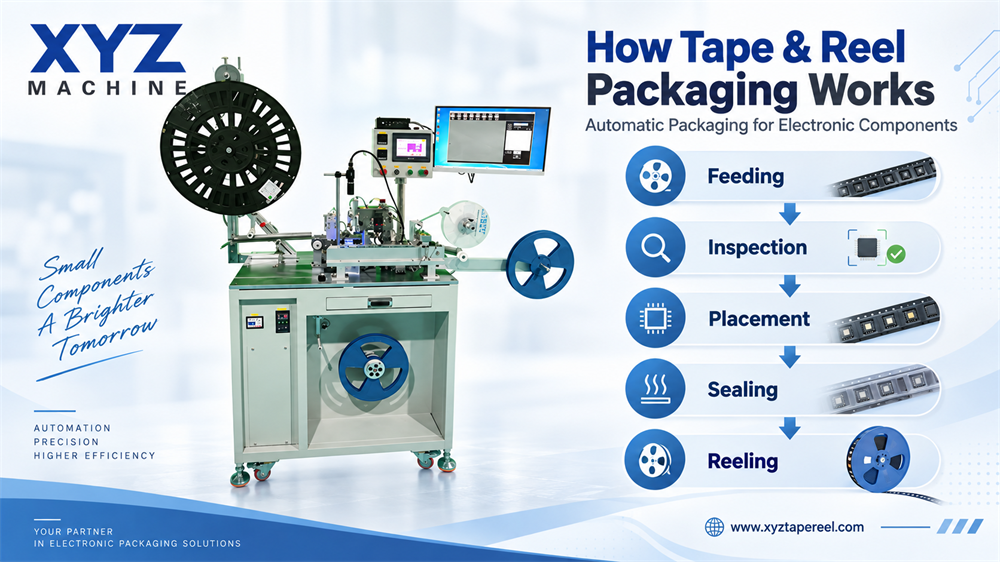
1. Component Feeding
Electronic components may arrive in several formats, including trays, tubes, bulk material or other temporary packaging. The feeding system transfers these parts into the automatic packaging process.
The specific feeding method depends on the component shape, production volume and packaging requirements.
For example, high-volume standardized components may use automatic feeding systems, while irregular or difficult-to-handle components may require customized feeding mechanisms.
Stable feeding is important because inconsistent part delivery can interrupt the entire taping process.
2. Inspection and Orientation Control
Before a component is placed into carrier tape, the system may inspect its orientation, position or external condition.
Automatic taping equipment can incorporate CCD vision systems to verify whether components are correctly oriented and whether obvious packaging abnormalities are present.
This is particularly important for components with polarity, defined mounting direction or sensitive surfaces.
XYZ automatic taping machines can use vision inspection to help confirm component orientation and identify missing or incorrectly positioned parts during the packaging process.
For customized applications, inspection can also be integrated with functions such as OCR recognition, electrical testing or automatic rejection before the component enters the carrier tape.
3. Accurate Placement into Carrier Tape
After inspection, the component is placed into an individual pocket in the carrier tape.
The dimensions of the pocket must match the component geometry.
A pocket that is too large may allow the component to move, tilt or rotate. A pocket that is too small may interfere with loading or downstream pickup.
Carrier tape design therefore directly affects packaging consistency and SMT feeding performance.
XYZ can design carrier tape pockets according to the dimensions and shape of the customer's component. The company supports a range of materials and carrier tape widths, including customized solutions for standard and non-standard electronic parts.
4. Cover Tape Sealing
Once components are positioned inside the carrier tape pockets, cover tape is applied.
The purpose of cover tape is to keep the components securely inside the pockets while still allowing the tape to be peeled away smoothly during SMT feeding.
The sealing process must balance packaging security with controlled peel performance.
XYZ equipment can support different sealing methods depending on the carrier tape and cover tape configuration. The company's taping machines are designed to maintain consistent sealing while controlling tape tension and packaging quality.
5. Reeling and Final Packaging
After sealing, the finished carrier tape is wound onto a reel.
The reel provides a compact, standardized format for storage, transportation and automated feeding.
Depending on production requirements, the system may also integrate counting, labeling or traceability functions.
For high-volume electronics manufacturing, this standardized reel format simplifies material handling and enables components to move efficiently from packaging operations to SMT production lines.
Why Is Carrier Tape Important?
Carrier tape is one of the most critical parts of the tape and reel packaging system. Its dimensions, material, pocket geometry, surface properties and mechanical stability all affect packaging performance.
XYZ produces carrier tape using different materials, including PC, PET, PP, PS and PVC, depending on customer and application requirements. Carrier tape can also be customized in areas such as color, transparency and surface resistance.
Carrier Tape Requirement | Typical Consideration |
Pocket Dimensions | Must match component size and geometry |
Tape Width | Selected according to component dimensions and feeder requirements |
Pocket Depth | Must provide sufficient protection without restricting pickup |
Material | Selected according to mechanical, temperature or application requirements |
ESD Performance | Important for static-sensitive electronic components |
Transparency | May be required for optical inspection applications |
Pitch Accuracy | Supports consistent advancement through SMT feeders |
Cover Tape Compatibility | Influences sealing strength and peel performance |
XYZ can manufacture carrier tape in widths from approximately 8 mm to 104 mm for different electronic component packaging applications.
What Components Can Be Packaged in Tape and Reel?
Component Type | Typical Packaging Requirement |
ICs and Semiconductor Devices | Precise positioning and ESD protection |
Sensors | Orientation control and customized pocket design |
LED Components | Inspection, sorting and automated packaging |
Connectors | Deeper or customized carrier tape pockets |
Resistors and Capacitors | High-speed, high-volume packaging |
Inductors | Stable positioning and controlled orientation |
Transformers | Customized feeding and larger carrier tape formats |
Automotive Electronic Components | Reliability, traceability and ESD control |
Industrial Electronic Components | Flexible packaging for different sizes and production volumes |
XYZ's packaging solutions are used across consumer electronics, automotive electronics, industrial control and medical electronic applications, each with different requirements for reliability, flexibility, cleanliness and traceability.
Automatic vs. Semi-Automatic Taping Machines
The correct taping machine depends on production volume, component variety and automation requirements.
Factor | Automatic Taping Machine | Semi-Automatic Taping Machine |
Production Volume | Medium to high volume | Small to medium volume |
Automation Level | High | Moderate |
Feeding | Automatic or integrated feeding | More operator involvement |
Changeover Flexibility | Suitable for stable production | Suitable for higher-mix production |
Labor Requirement | Lower | Higher |
Typical Application | Continuous production | Flexible or multi-product packaging |
XYZ provides both automatic and semi-automatic taping equipment to support different manufacturing environments. Semi-automatic machines can be particularly useful for customers handling smaller production quantities or frequent component changes, while automatic taping machines are more suitable for continuous and higher-volume packaging operations.
When Is a Customized Tape & Reel Solution Needed?
Standard taping equipment is suitable for many electronic components, but some applications require additional automation. Customized solutions may be necessary when the customer needs inspection, sorting, testing or packaging integrated into a single production process.
Custom Function | Application Value |
CCD Vision Inspection | Checks orientation, position or appearance |
OCR Recognition | Confirms component type or identification |
Electrical Testing | Verifies component performance before packaging |
Sorting | Separates components according to defined criteria |
Automatic Rejection | Removes non-conforming components |
Custom Feeding | Handles irregular or non-standard component shapes |
Custom Carrier Tape | Supports special dimensions or component geometries |
Traceability Integration | Records packaging or inspection data |
XYZ has developed customized systems combining inspection, testing and taping into integrated automation processes, including applications for network transformers, LEDs, ICs and other electronic components.
How Tape & Reel Packaging Supports SMT Production
The purpose of tape and reel packaging is not simply to store electronic components.
A properly designed tape and reel system supports the entire SMT production chain.
It can help manufacturers achieve more consistent component orientation, stable feeder operation, automated material handling and improved production continuity.
As electronic products continue to become smaller and component varieties increase, packaging systems must also become more precise and flexible.
This is why carrier tape design, feeding technology, inspection systems and automation increasingly need to be considered as one integrated packaging solution.
XYZ Tape & Reel Packaging Solutions
XYZ Solution | Main Application |
Automatic Taping Machines | High-efficiency automated tape and reel packaging |
Semi-Automatic Taping Machines | Flexible packaging for smaller batches and multiple component types |
Carrier Tape | Standard and customized component packaging |
Cover Tape and Reels | Complete tape and reel packaging system |
Carrier Tape Forming Equipment | In-house carrier tape manufacturing |
Taping Processing Services | Outsourced tape and reel packaging |
Custom Automation | Integrated testing, inspection, sorting and packaging |
XYZ positions itself between electronic component manufacturing and SMT assembly, helping customers convert electronic components into standardized, SMT-ready tape and reel packages.
Frequently Asked Questions
What is tape and reel packaging?
Tape and reel packaging is a method in which electronic components are placed into carrier tape pockets, sealed with cover tape and wound onto reels for automated SMT feeding.
What is an automatic taping machine?
An automatic taping machine loads electronic components into carrier tape and automates processes such as feeding, inspection, placement, sealing and reeling.
What is carrier tape used for?
Carrier tape holds individual electronic components in defined pockets and enables controlled feeding into SMT placement equipment.
Which electronic components can be packaged using tape and reel?
Tape and reel packaging can be used for ICs, sensors, LEDs, connectors, resistors, capacitors, inductors, transformers and many other electronic components.
Can carrier tape be customized?
Yes. Carrier tape pockets can be designed according to component dimensions, shape, ESD requirements, material requirements and packaging conditions.
Can inspection and testing be integrated with taping?
Yes. For customized automation projects, vision inspection, OCR, electrical testing, sorting and automatic rejection can be integrated before final tape and reel packaging.
Conclusion
Tape and reel packaging is a critical link between electronic component manufacturing and automated SMT assembly.
A reliable system requires more than a reel and carrier tape. It requires coordinated control of feeding, inspection, placement, sealing, reeling and carrier tape design.
For manufacturers handling standard or customized electronic components, selecting the correct taping equipment and carrier tape solution can improve packaging consistency and support more stable downstream automation.
XYZ provides automatic taping machines, carrier tape, taping services and customized electronic component packaging automation for global electronics manufacturers.
